

Perspective Matters
By Horst Siegler
“I suck at art.” The stage whisper carried across the room, barely disguised.
But I’m getting ahead of myself. It had started as an ordinary Friday afternoon.
I walked into class at 1:00 PM and announced, “OK, everyone, clear your desk; it’s time for art.” There were some muted cheers, upraised hand pumps, and a few quiet groans, accompanied by rolled eyeballs. It was impossible to predict just how any announcement would be received by a group of grade sevens, mine included, and I could rarely predict what would happen next.
It was Friday afternoon on a warm, sunny day in October. By now, I had gotten to know my class pretty well in the few weeks since the beginning of the school year, and they had come to know me—Mr. S., as the students called me.
The twelve- and thirteen-year-old students from the middle-class neighbourhood represented an interesting cross-section of pre-teens and teenagers, from the slightly smartass to the quiet, wouldn’t say boo to a fly type of young person. I enjoyed them all.
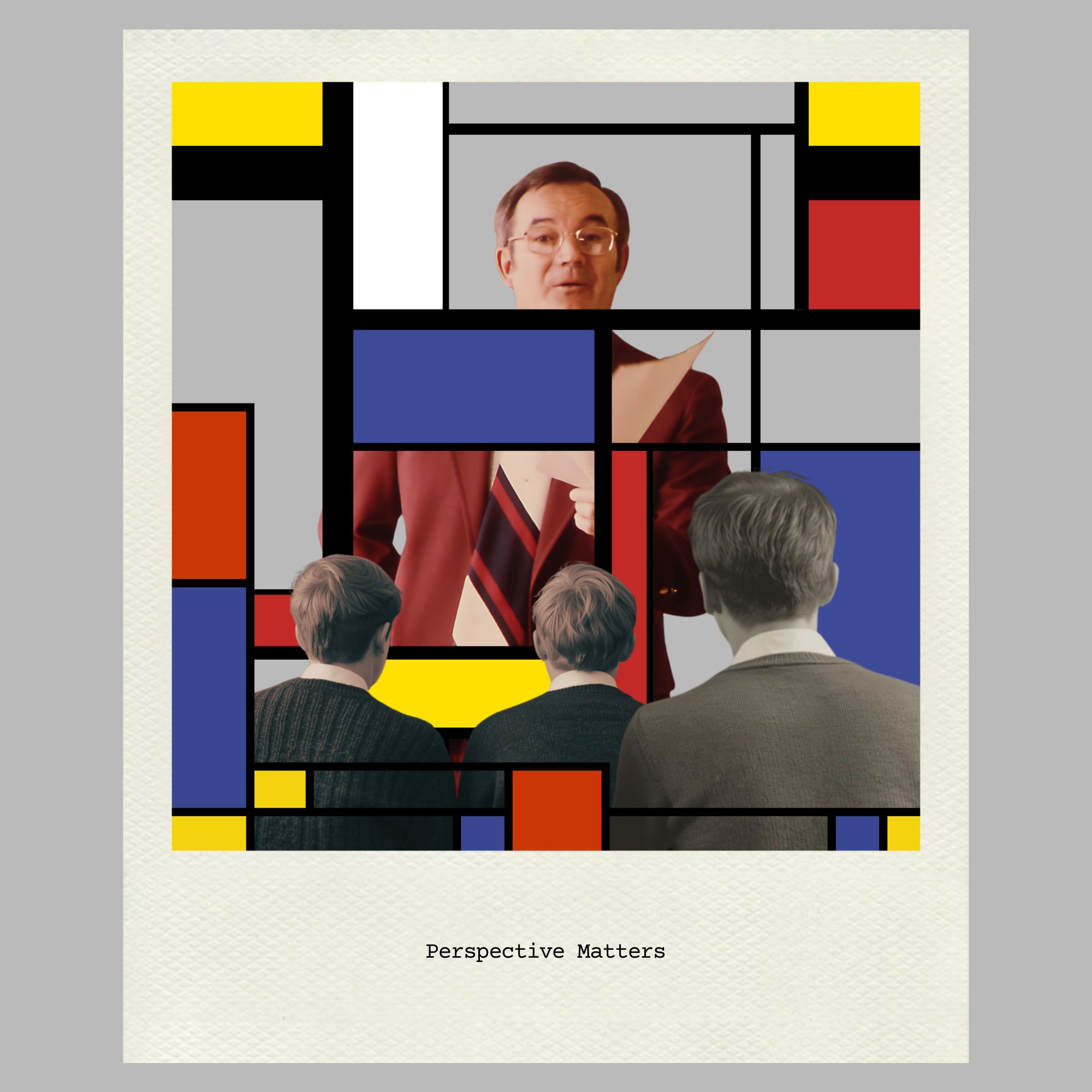
“Please look to the front. I have posted a few examples of the art of Piet Mondrian, the Dutch artist we’re going to try to emulate this week. You’ll notice that his work begins as fairly ordinary works and gradually morphs into what we often see from him in his later years, art he called Neo-Plasticism. What do you think?”
“His work starts out like real art,” said Amy, putting air quotes around the word real.
“What you call real is called representational in art circles,” I replied. “When your parents ask you what you learned in school today, tell them you learned about representational art and watch the expression on their faces. Could be interesting.” Some of the students chuckled.
“How did he get from where he started to where he ended up? You know—how did he get here from there?” Drew wanted to know.
“That is a really good question, Drew, but it’s too long a story for our art lesson. Besides, I’d like to get you going on your project for this week rather than talk about Piet’s artistic journey.”
Jamie had her hand up and commented, “Well, anyone can do the Neo-Plasticism stuff he’s known for, can’t they, Mr. S?”
“That’s what we’re going to find out, Jamie.”
The instructions to create Mondrian designs were simple enough: squares and rectangles of card in different sizes, a ruler, eraser, pencil, and fat black felt pens. Lay down your lines, fill them in with bright colours — Mondrian’s signature.
“Any questions?” There were none. “OK, get to work.”
There was a lot of hubbub as the students got the materials they needed, but gradually they quieted as they began their work. I interrupted them occasionally to show them work by their classmates. Skinny black felt lines tended to create a light feel to the art whereas heavy lines created a more solid feel. Colours like reds, oranges, and yellows were warm and blues and greens were cool. The distribution of coloured areas made a big difference to the overall look of the pieces, so I stressed that composition matters.
Some had put designs into the shapes, something we hadn’t discussed at all, which gave me an opportunity to praise those students for their creativity.
I wandered around the class to offer words of encouragement and praise. As I passed Drew’s desk, I heard him mutter, “Man, I suck at art.”
Feeling I could make a difference in his view of both the quality of his art and his view of himself, I paused to look at what he had done.
“You know, Drew, this looks good. Maybe, if you were a bit more positive, you might feel differently.”
He looked down to study his work for a moment. Then he raised his head, smiled, and replied, “You know, Mr. S., I’m positive I suck at art.”
Horst Siegler — octogenarian, father, grandfather, teacher, coach, carpenter, ski instructor, commercial and street photographer, financial advisor, author. Curmudgeon.
My morning chuckle became a guffaw. Loved this.
This is a great story with a perfect punchline! Thank you.